
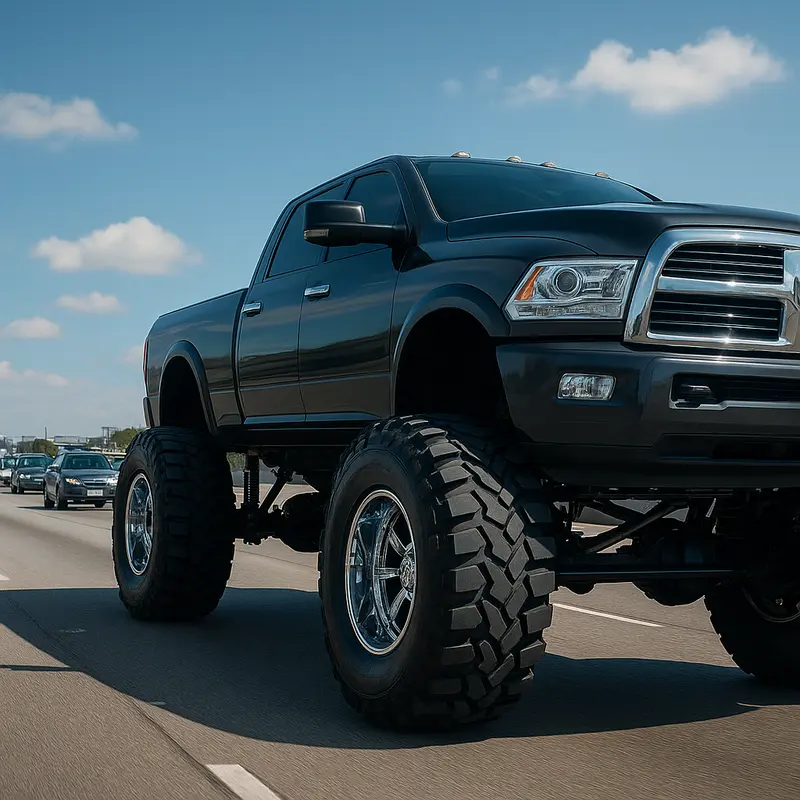
Big wheels to beat traffic and look down on everyone? Let’s roll into reality.
Short answer: Bigger wheels give you height and style, maybe a better view, but they won’t magically part traffic like Moses. In fact, they often bring trade-offs that can make your commute worse — and your wallet lighter.
Do big wheels help you avoid traffic? Not really. Traffic is about congestion, not ego. However, a higher ride (lift kits, bigger tires) can give better forward visibility and let you see brake lights sooner, which might help reaction time by a second or two. That’s useful, but it’s not a traffic cheat code.
Real effects of upsizing wheels
Visibility & presence: You will literally be looking down on sedans. That height can be a safety plus in seeing over cars, but it also changes sightlines for smaller vehicles and pedestrians.
Ride comfort: Larger-diameter wheels usually come with lower-profile tires. That means stiffer sidewalls and a harsher ride — you’ll feel potholes more. If you want comfort, keep some sidewall (higher aspect ratio).
Handling & braking: Bigger wheels increase rotating and unsprung mass unless you choose lightweight alloys. More mass = slower acceleration, longer braking distances, and possible reduced cornering agility.
Fuel economy: Heavier wheels and wider tires raise rolling resistance and weight, hurting MPG. So your crown of superiority may come with more stops at the pump.
Speedometer & gearing: Changing wheel diameter can throw off odometer/speedometer accuracy and can slightly alter effective gearing. Recalibration or keeping overall diameter close to stock fixes that.
Clearance & suspension: Bigger wheels can rub and require lift or fender mods. Lifting raises center of gravity — good for view, bad for rollovers and handling. Alignment becomes crucial to prevent uneven tire wear.
Brakes & drivetrain: Bigger wheels can stress brakes; you may need bigger rotors or upgraded pads. Increased mass also puts extra load on wheel bearings, axles, and suspension components.
Legal, warranty & insurance: Local laws limit lift heights and modifications in many places. Aftermarket mods might void parts of your warranty and affect insurance. Check regulations before you go full skyscraper.
Costs: Bigger wheels, new tires, lift kits, alignment, brake upgrades, possible ECU recalibration — it adds up fast. Stylish, yes. Cheap, not so much.
Want big wheels without buyer’s remorse?
Keep overall diameter close to stock — that preserves speedometer accuracy and gearing.
Use taller sidewalls if you want comfort — low-profile is flashy but harsh.
Choose lightweight wheels to reduce unsprung mass.
Upgrade brakes and suspension as needed and get a pro alignment.
Check local laws and your insurer before you lift off.
And about that whole “looking down on everyone” vibe: Sure, you’ll have a literal height advantage and maybe an inflated ego — but road manners don’t come with wheel size. Be considerate: big wheels don’t excuse tailgating, curb-hugging, or slow parking. Tread lightly — and tread responsibly.
Final thought: If your goal is to outmaneuver traffic, invest in smart route apps, flexible departure times, or even a scooter for last-mile escapes. If your goal is style and a better view, go for tasteful upgrades done right — just don’t expect traffic to bow down to your rims. After all, traffic has one universal rule: no rims, no mercy.
Instant VIP lane access with 24-inch rims — sadly, still fictional.


