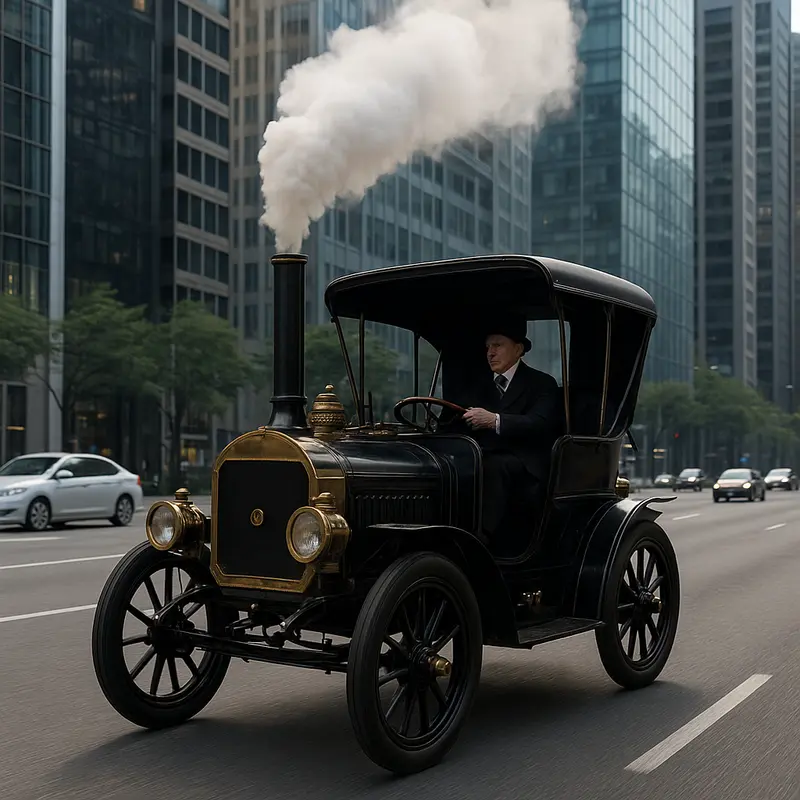
Steam Engine Car in a Modern City
Imagine a shiny boiler tucked where the battery used to be, hissing politely at a crosswalk while cyclists give it a curious double-take. A steam engine car weaving through city traffic sounds like a historian's daydream, but with modern tech and a pinch of engineering pixie dust it could be more than a museum piece — it could be a very photogenic niche on urban streets.
Why it's delightfully odd (and secretly sensible)
Steam propulsion is nothing new — Stanley Steamers were "wheely" a thing in the early 1900s — but today's materials, controls and emissions know-how turn vintage charm into potential practicality. Modern compact boilers (flash boilers), high-strength alloys and electronic control make startup times shorter and reliability higher. Add a condenser to reclaim water and you get a loop that doesn't demand a hydrant every couple of blocks.
Industry insight: Automakers and startups are obsessed with packaging and emissions. Steam systems trade heavy, high-voltage batteries for a different kind of package: a boiler, condenser, and heat exchangers. That shifts regulatory conversations from kilowatt-hours to thermal efficiency and particulate control — not an impossible swap, just a different rulebook.
Pit stops & practicalities
Water management, fuel type and safety are the headline challenges. You'd need a compact water tank, an efficient condenser to minimize refill frequency, and a safe, low-smoke fuel — think propane, biofuels, or even hydrogen if you're feeling futuristic. Noise and odor? Modern condensers and mufflers can make a steamer surprisingly civilized; it's less "choo-choo" and more "subtle sigh."
Regulatory roundup: city emissions zones, noise ordinances, crash safety standards and insurance codes don’t care whether you’re coal or cobalt — they care about emissions and risk. Any modern steam car would have to meet tailpipe-equivalent standards (particulates, NOx) and crash approvals just like EVs and ICE cars.
Where it fits in the urban ecosystem
Think boutique mobility, not mass-market disruption. Steam cars are poised for tourism fleets, experiential ride services, retro-parades, and artisans building low-volume specialty vehicles. Pair steam with electric drive (a steam-electric hybrid) and you get instant torque, regenerative braking, and a heat source that can top up a battery — a clever hybrid that gives "range extender" a sartorial upgrade.
Tech twist: use waste heat recovery, microturbines, or an organic Rankine cycle to squeeze more miles per drop of fuel. 3D printing and modern metallurgy cut weight and improve thermal efficiency, while sensors and control algorithms tame the boiler like a well-trained pup.
Final chuff (that's charm, not smoke)
Would a steam car replace your EV overnight? Unlikely. But could it carve out a delightful, sustainable niche in modern cities? Absolutely — if designers blend heritage aesthetics with contemporary emissions controls, smart packaging, and inventive refueling strategies. The result: a ride that's part history lesson, part tech demo, and all kinds of Instagrammable.
So next time you’re stuck at a red light, don’t get steamed — imagine the gentle hiss of a modern boiler and smile. Urban mobility always likes a little steam in its engine.