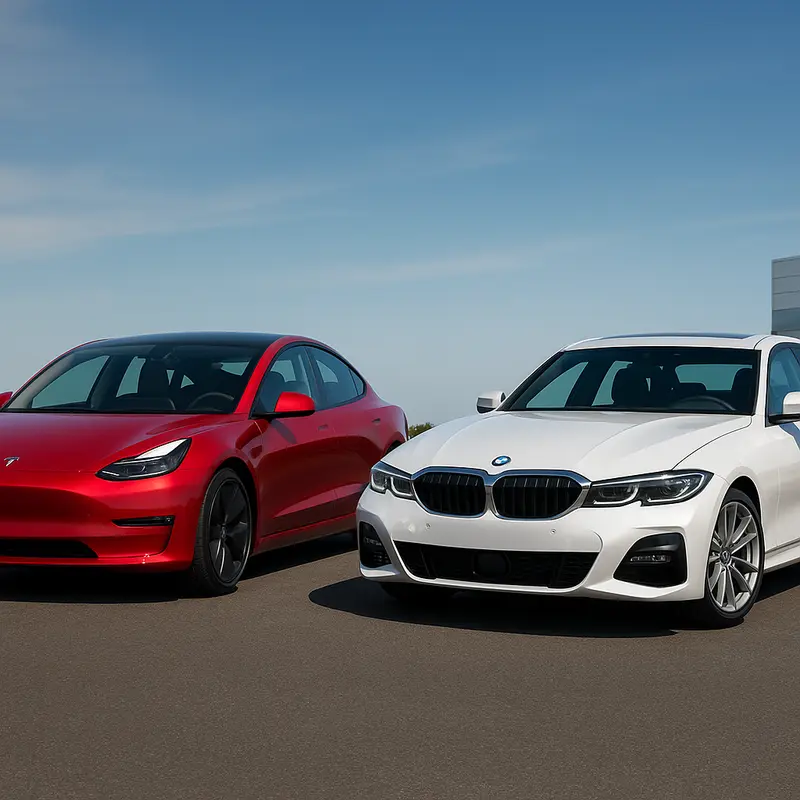
Tesla & BMW — Understanding the diversity between these cars
Brand philosophy and business model
Tesla positions itself as a technology-first EV company: vertical integration, direct sales, and rapid software-driven updates. BMW is a legacy automaker focused on premium engineering, driver engagement and a broad portfolio that spans internal-combustion, hybrid and electric vehicles. This creates fundamentally different customer expectations and purchase experiences.
Powertrains and platform strategy
Tesla builds dedicated electric platforms optimized for battery packaging, range and low center of gravity. BMW historically used ICE platforms and adapted them to electrification but is now investing in dedicated EV architectures (Neue Klasse) to compete head-on. Result: Tesla often has range and packaging advantages; BMW aims to combine EV efficiency with traditional dynamics and premium feel.
Design and driving dynamics
Tesla design emphasizes minimalism, aerodynamics and interior simplicity driven by a large central screen. BMW emphasizes driver-oriented cockpits, chassis tuning and handling — traits that appeal to drivers who prioritize steering feedback and road feel. Both achieve performance, but the character differs: Tesla leans toward straight-line acceleration and software control, BMW toward tuned handling and tactile feedback.
Software, connectivity and ADAS
Tesla treats software as a core product: over-the-air updates, integrated energy and navigation ecosystem, and the controversial Full Self-Driving (FSD) roadmap. BMW offers sophisticated driver-assist systems and connected services, but historically paced software rollout more cautiously and relies on partnerships for mapping and cloud services.
Manufacturing, supply chain and scale
Tesla vertically integrates batteries, electronics and assembly at large gigafactories to reduce cost and speed iterations. BMW operates global plants with supplier networks, balancing flexible production across models and powertrains. Industry trend: both are investing in battery cell sourcing and local production to hedge supply risks and meet regulatory demands.
Charging, service and ownership
Tesla’s Supercharger network is a competitive advantage for long-distance EV ownership. BMW owners rely on expanding public charging networks and brand partnerships. Service models differ: Tesla emphasizes mobile service and fewer dealer touches; BMW uses its dealer network for sales, maintenance and used-car remarketing.
Market positioning and pricing
Tesla carved a direct path into EV volume and premium segments with relatively simple trim structures. BMW competes across segments — entry luxury to flagship — offering choice in powertrains and bespoke options. This diversity means BMW can serve traditional luxury buyers while transitioning to electrification.
Safety, regulations and sustainability
Both brands respond to tightening emissions standards and EV incentives globally. Tesla emphasizes lifecycle emissions by selling fewer tailpipe-emission vehicles; BMW balances carbon footprint through efficient ICEs, hybrids and EV rollouts, plus commitments to sustainable materials and circular supply chains.
Takeaway: Tesla and BMW now overlap in EV offerings, but they remain distinct. Tesla is software-centric, vertically integrated and EV-first. BMW brings decades of chassis expertise, luxury craftsmanship and a multi-powertrain strategy. Choosing between them depends on whether you value cutting-edge software and charging convenience or traditional driving dynamics, brand options and dealer-backed service.
For buyers: test drive both, evaluate real-world range and charging access, consider service network and expected software roadmap, and weigh resale expectations based on local markets and incentives.